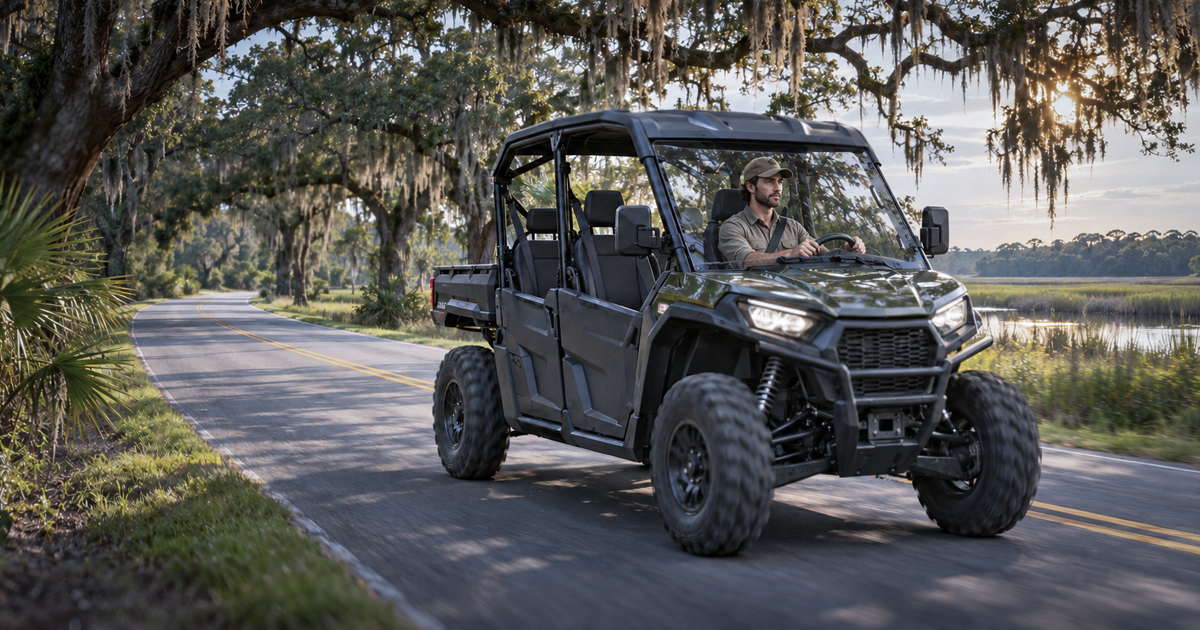
Utility terrain vehicles (UTVs), commonly known as side-by-sides, are popular for recreation, outdoor activities and getting around communities. In South Carolina, however, these vehicles have generally not been permitted on public roads. That is scheduled to change on November 18, 2026, when a new state law allows qualifying UTVs to operate on certain public streets and highways.
The change does not mean that every UTV will be street legal or that owners can drive these vehicles wherever they choose. The law establishes specific vehicle, registration, insurance, driver and roadway requirements. Anyone who owns a UTV or is considering purchasing one for public-road use should understand these rules before taking it onto the road.
What Qualifies as a UTV Under South Carolina Law?
The new law defines a UTV as a side-by-side, four-wheel-drive, off-road vehicle designed to transport people, cargo or both. To qualify for the new road-use provisions, a vehicle must meet all of the following requirements:
- Have a top speed greater than 55 miles per hour.
- Have an engine displacement of at least 450cc.
- Have a gross vehicle weight rating of 4,000 pounds or less.
- Measure no more than 80 inches in width.
- Be equipped with a steering wheel rather than handlebars.
- Have non-straddle seating.
These specifications are important because not every off-road vehicle, golf cart or recreational vehicle will meet the statutory definition. Owners should confirm that their particular model qualifies before assuming it can be registered for use on public roads.
Beginning November 18, 2026, a qualifying UTV may be operated on certain public roads only after meeting the law’s requirements.
Title, registration and insurance. The UTV must be titled and registered with the South Carolina Department of Motor Vehicles (SCDMV), and it must have liability insurance. An official license plate must be displayed on the rear of the vehicle. The driver must also carry the registration certificate and proof of liability insurance while operating the UTV on a public road.
Owners who do not intend to operate their UTVs on public roads are not required under this law to register or insure them for that purpose. A street-legal UTV must have working headlights, taillights, brake lights and turn signals. It must also have Type 2 seat belts at every seating position.
These requirements are intended to help make UTVs more visible to other motorists and provide occupant protection while traveling on public roads.
South Carolina’s new law establishes operating raduius, age restrictions, and licensing requirements.
A person operating a UTV on a public road must be at least 17 years old and have a valid Class D driver’s license in his or her possession. Passengers must be at least 8 years old, and drivers and passengers under the age of 21 must wear a helmet with a face shield or goggles while the UTV is being operated on a public road. These requirements apply even when the UTV is being used for a short trip within a neighborhood or community.
UTVs may be driven only on secondary highways or streets where the posted speed limit is 55 miles per hour or less, but they are not permitted on interstate highways. A UTV must remain within 10 miles of the address listed on its registration certificate. If the registered address is located within a gated community, the 10-mile distance is measured from an entrance to that community.
UTV Drivers Must Follow Traffic Laws and Safety Guidelines
Although UTVs are different from traditional passenger vehicles, their operators will be subject to applicable general traffic laws when driving on public roads. This includes laws addressing driving under the influence (DUI), speeding, seat belt use, and hands-free device requirements. The fact that a UTV may be capable of traveling at speeds comparable to other vehicles also does not eliminate the need to use caution.
The 2024 Report of Deaths and Injuries Involving Off-Highway Vehicles with More than Two Wheels by the US Consumer Product Safety Commission (CPSC) tracked hundreds of annual deaths involving recreational off-highway vehicles (ROVs) and UTVs, noting that over 90% of pediatric ATV/OHV deaths and serious injuries involve riding in vehicles sized for adults. Two-thirds of fatal off-road vehicle crashes happen on public or private roads rather than designated trails, despite state rules restricting many of these vehicles from public paved highways. In South Carolina during the period of 2019 to 2021, there were 55 reported fatal incidents involving UTVs and 57 reported deaths from incidents with UTVs.
The ability to operate qualifying UTVs on certain South Carolina roads may provide owners with additional convenience, particularly in communities where these vehicles are commonly used for recreation and short trips. Some models offer features such as enclosed cabins, heating and air conditioning, seat belts and protective roll cages. However, those features should not be mistaken for the same level of protection provided by a conventional passenger vehicle. UTVs are designed primarily for off-road use, and their handling, stability and occupant protection can differ from those of cars and trucks. A roll cage and seat belts do not eliminate the risk of serious injury in a collision or rollover.
Parents and guardians should also pay close attention to the law’s minimum passenger age and helmet requirements. The fact that a child is permitted to ride in a UTV does not mean every vehicle or seating arrangement is appropriate for that child.
What Happens if a UTV Is Involved in an Accident?
As qualifying UTVs become permitted on certain public roads, accidents involving these vehicles may raise questions about traffic violations, insurance coverage and responsibility for injuries or property damage. A collision between a UTV and a passenger car, truck, motorcycle, or another vehicle can involve many of the same issues that arise in other motor vehicle accident cases. However, the UTV’s classification and the requirements of the new law may add important considerations.
When an accident occurs on a public road, law enforcement may investigate the collision, document the circumstances and determine whether traffic laws were violated. Depending on the facts, the investigation may include whether the UTV met the requirements for public-road use, whether it was properly registered and insured, whether required safety equipment was present, and whether the driver was operating within applicable roadway and geographic restrictions.
When a UTV accident results in injuries or property damage, an insurance claim may be made against the person believed to be responsible for the collision. South Carolina generally follows an at-fault system for motor vehicle accidents, meaning that responsibility for damages is evaluated based on the parties’ actions and the circumstances of the crash. The availability and amount of insurance coverage will depend on the applicable policies and the facts of the accident. If the responsible party does not have sufficient insurance, or if a coverage dispute arises, determining what options may be available can become more complicated.
For example, an accident involving a UTV outside the permitted operating area or on a prohibited roadway may raise questions about whether the operator violated the law. A missing seat belt, defective lighting or failure to use required safety equipment may also be relevant. These circumstances can become important when insurance companies and attorneys evaluate how an accident occurred and who may be responsible. However, a violation of the UTV law does not automatically establish liability for an accident. The specific facts must be considered, including whether a violation contributed to the collision or resulting injuries.
South Carolina requires qualifying UTVs operated on public roads to carry liability insurance. The law ties that coverage to the state’s motor vehicle financial responsibility requirements. This is an important change for owners who previously used their vehicles exclusively for off-road recreation. UTV owners should review their insurance policies carefully and confirm that the coverage applies to the vehicle’s intended use on public roads. An off-road recreational vehicle policy or homeowners insurance policy should not be assumed to provide the liability coverage required for street use. Coverage can depend on the policy’s terms, exclusions and endorsements.
If you own a UTV or are considering purchasing one, take time to review the new requirements before planning to drive on public roads. Confirm that your vehicle meets the statutory definition, determine what is needed for titling and registration, obtain the required liability insurance, and make sure all required lighting and seat belts are in place. It is equally important to understand the restrictions on driver and passenger ages, permitted roadways and travel distance.
Understanding Your Rights and Responsibilities on the Road
As more UTVs become eligible to operate on South Carolina roads, motorists will be sharing roadways with vehicles that may handle and perform differently from traditional cars and trucks. UTV operators and other drivers alike should understand the rules, remain attentive, and take reasonable precautions to help prevent accidents.
When a collision involving a UTV or another motor vehicle results in injuries, determining what happened may require a careful review of the circumstances, applicable traffic laws, vehicle equipment and the actions of everyone involved.
The Floyd Law Firm PC has served individuals and families throughout the Grand Strand and South Carolina for more than five decades. Our personal injury attorneys understand that an unexpected accident can create significant physical, financial and personal challenges. If you or someone in your family has been injured in a motor vehicle or UTV-related accident, our team can help you understand your legal options and determine what steps may be appropriate for your circumstances.
Learn More:
UTV laws in SC Code of Laws: Section 56-2-5000 through Section 56-2-5130
Golf Cart Accidents and Safety Laws in South Carolina
Bicycle Accidents in South Carolina: How Bike Injury Cases Differ From Car Accidents