
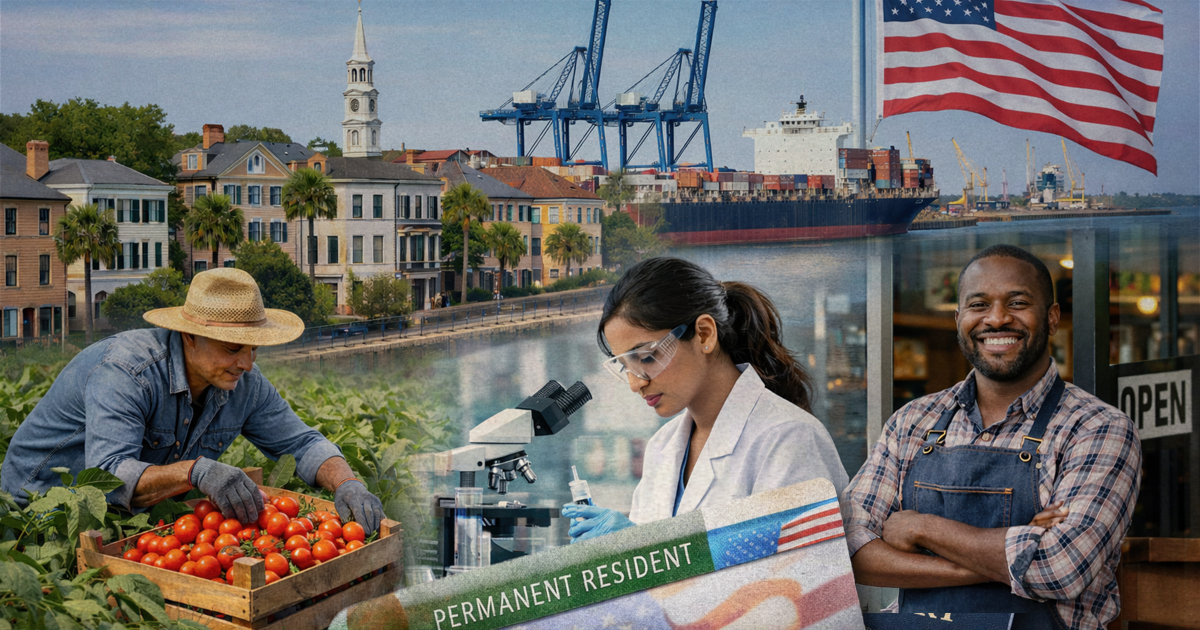
Immigration plays a vital role in South Carolina’s economic growth, workforce stability, and community life. Across the state, immigrants contribute as business owners, employees, taxpayers, and neighbors, strengthening industries that are essential to South Carolina’s success. As immigration laws continue to evolve and enforcement grows more complex, experienced legal guidance has become increasingly important for both individuals and employers.
Immigration’s Impact on South Carolina’s Economy
South Carolina is home to a substantial and growing immigrant population. Approximately 5.8 percent of the state’s residents are foreign-born, and 3.2 percent of U.S.-born residents live with at least one immigrant parent. These individuals are deeply integrated into the fabric of South Carolina communities and the state’s workforce.
Immigrants make up 7.7 percent of South Carolina’s labor force, with especially strong representation in key sectors. They account for 19.7 percent of the agricultural workforce, 12 percent of STEM (Science, Technology, Engineering, and Mathematics) professionals, and more than 11 percent of entrepreneurs statewide. Their economic footprint is significant—an estimated 314,000 immigrant residents contribute more than $10.2 billion in spending power, while paying approximately $3.5 billion in state and local taxes each year.
Entrepreneurship, in particular, highlights the importance of immigration. New businesses are a primary driver of job creation in the United States, and immigrants consistently start businesses at higher rates than the general population. Millions of American workers today are employed by immigrant-founded or immigrant-owned companies, reinforcing the connection between lawful immigration and economic opportunity.
Understanding the Path to Permanent Residency and Citizenship
While immigration offers opportunity, the legal process can be lengthy and complex. For many individuals, the first major step is obtaining lawful permanent residency, commonly known as a Green Card. This process often depends on family or employment sponsorship and may involve long waiting periods due to annual visa limits and country-based caps. In some cases, applicants wait years—or even decades—before a visa becomes available.
After obtaining permanent residency, most individuals must wait five years before becoming eligible to apply for U.S. citizenship through naturalization, while spouses of U.S. citizens may qualify after three years. In practice, the timeline is often longer. The median time spent as a lawful permanent resident before naturalization in fiscal year 2024 was 7.5 years.
The naturalization process itself includes meeting residency and physical presence requirements, submitting Form N-400, completing biometrics, attending an interview, and passing English and civics examinations. Processing times for naturalization applications generally range from eight to fourteen months, depending on the applicant’s circumstances and the workload of the local USCIS office.
Numerous factors can affect immigration timelines, including visa backlogs, country of origin, application accuracy, and regional processing delays. Because immigration laws are among the most complex in the world, even small errors or missed deadlines can lead to costly delays or denials.
Given these challenges, experienced legal representation is essential. Our immigration practice may include assistance with:
- Employment verification and I-9 compliance
- Employment-based visas and permanent residency applications
- Visa programs for students, interns, and trainees
- B-1 Temporary Business Visitor Visa
- B-2 Tourist Visitor Visa
- F-1 Academic Student Visa
- H-1B Temporary Worker Visa
- H-2B Temporary Non-Agricultural Worker Visa
- L-1 Intra-company Transfer Work Visa
We also work closely with businesses seeking to employ qualified international workers, helping them remain compliant with federal immigration regulations while meeting workforce needs. For individuals, we offer strategic guidance to pursue lawful pathways that support long-term stability and opportunity in South Carolina.
Supporting South Carolina’s Future
Immigration is not only a legal process—it is a cornerstone of South Carolina’s economic vitality and community growth. At The Floyd Law Firm PC, we are committed to helping our clients navigate immigration law effectively and responsibly. Whether you are seeking to build a future for yourself and your family, or to strengthen your business through lawful employment practices, our attorneys are here to help.
More Information
American Immigration Council: Immigrants in South Carolina
United States Citizenship and Immigration Services
U.S. Citizenship and Immigration Services (USCIS) – Español
USA Facts: How long can it take to become a US citizen?
Protecting Your Business and Employees Amid Immigration Concerns
A Vital Workforce: The Importance of Immigration in South Carolina